

The convergence of artificial intelligence, high-performance computing and quantum technologies will reshape how digital infrastructure is designed and operated. At Danish Data Center Industry’s latest networking meetup, industry experts, researchers and infrastructure providers gathered to discuss what these developments realistically mean for data centers, and what Denmark must get right to remain competitive.
The discussions throughout the afternoon pointed to a common theme: the next generation of computing will depend not only on technological breakthroughs, but also on the infrastructure needed to run them.
Opening the meetup, CEO Henrik Hansen reflected on the broader political context surrounding the industry. “We are in the middle of an election campaign, but not a lot of people are talking about the digital economy – which we think is very important. We will do what we can from our side to push this agenda.”
At the same time, demand for digital infrastructure continues to grow rapidly as AI adoption accelerates across industries. Hansen pointed to figures from Energinet indicating that roughly 15 GW of potential data center capacity is currently in the connection pipeline, which is more than double Denmark’s current peak electricity demand.
However, the figure reflects project pipelines rather than actual demand. Many applications are early-stage proposals, and other sectors such as batteries and Power-to-X are also contributing to the growing queue for grid access. Energinet recently introduced a temporary pause on new grid connection applications while implementing a new maturity prioritization model.
DDI’s upcoming market report, to be published later this spring, will aim to bring more realistic perspectives into the public debate around infrastructure demand.
New whitepaper highlights the infrastructure challenge
The meetup also marked the launch of a new whitepaper exploring Denmark’s role in the emerging hybrid computing landscape.
Presenting the report, Merima Dzanic, Head of Strategy & Operations at Danish Data Center Industry, emphasized that the shift from research environments to operational infrastructure will be a defining development for the digital economy.
“Denmark has a quantum strategy. Denmark has an AI strategy. But Denmark does not have a data center strategy. You can’t build a house without the foundation.”
The whitepaper highlights how hybrid AI–quantum computing will increasingly depend on tightly integrated infrastructure, where AI systems, high-performance computing and emerging quantum processors operate together inside advanced data center environments.
Countries that align digital infrastructure, energy systems and research investments early on will be best positioned to translate technological breakthroughs into industrial competitiveness and economic growth.
Legal complexity grows alongside digital infrastructure
The expansion of digital infrastructure is also creating new legal and regulatory challenges.
Law firm Gorrissen Federspiel, also the hosts of the networking meetup, recently established a dedicated cross-functional team focused on the data center sector. Partner Christian Halskov Saur explained that the firm has worked with infrastructure and technology companies for many years, but that the growing scale and complexity of the sector has created the need for deeper specialization. “Where there is complexity, there is room for us.”
His colleague Tue Goldschmieding highlighted that data center investments must increasingly navigate long time horizons in a rapidly evolving technological landscape. Compliance requirements, cybersecurity considerations, geopolitical developments and supply-chain dependencies are all becoming part of the regulatory landscape surrounding digital infrastructure.
At the same time, many regulatory frameworks originate at EU level while interpretation and implementation may differ between member states, creating additional complexity for companies operating across borders.
Quantum computing enters the infrastructure discussion
Stefan Jofors, Senior Analyst at DatacenterHawk, provided an overview of the global quantum landscape and its potential implications for digital infrastructure. Quantum computing remains in its early stages and most existing installations remain research-focused. However, global investment is accelerating rapidly as governments and technology companies compete to develop commercially viable systems.
Technology companies such as IBM, Alphabet, Microsoft and Amazon are investing heavily, with many analysts expecting the first commercially relevant systems to emerge toward the end of the decade.
Rather than replacing classical computing systems, quantum technologies are expected to operate alongside them.“What everyone agrees on is quantum is coming and it will have to be integrated into existing data centers, cloud and everything we do,” said Stefan Jofors. This hybrid model will require new forms of infrastructure integration between AI systems, high-performance computing environments and quantum processors. For data center operators this raises new infrastructure questions, including cryogenic cooling, vibration shielding, specialized power systems and hybrid connectivity between different compute architectures.
Engineering the next generation of AI-ready data centers
Artificial intelligence is already changing how data centers must be designed and operated. In his presentation, Nikolaj Haaning, Director of Innovation & Sustainability at Rambøll, explored the practical engineering implications of AI infrastructure, where rack densities, cooling systems and power requirements are increasing rapidly.
Liquid cooling systems are becoming increasingly necessary as compute density rises, while facilities must adapt to heavier racks, higher power loads and new thermal management requirements.
Panel discussion: Can Denmark scale the infrastructure needed?
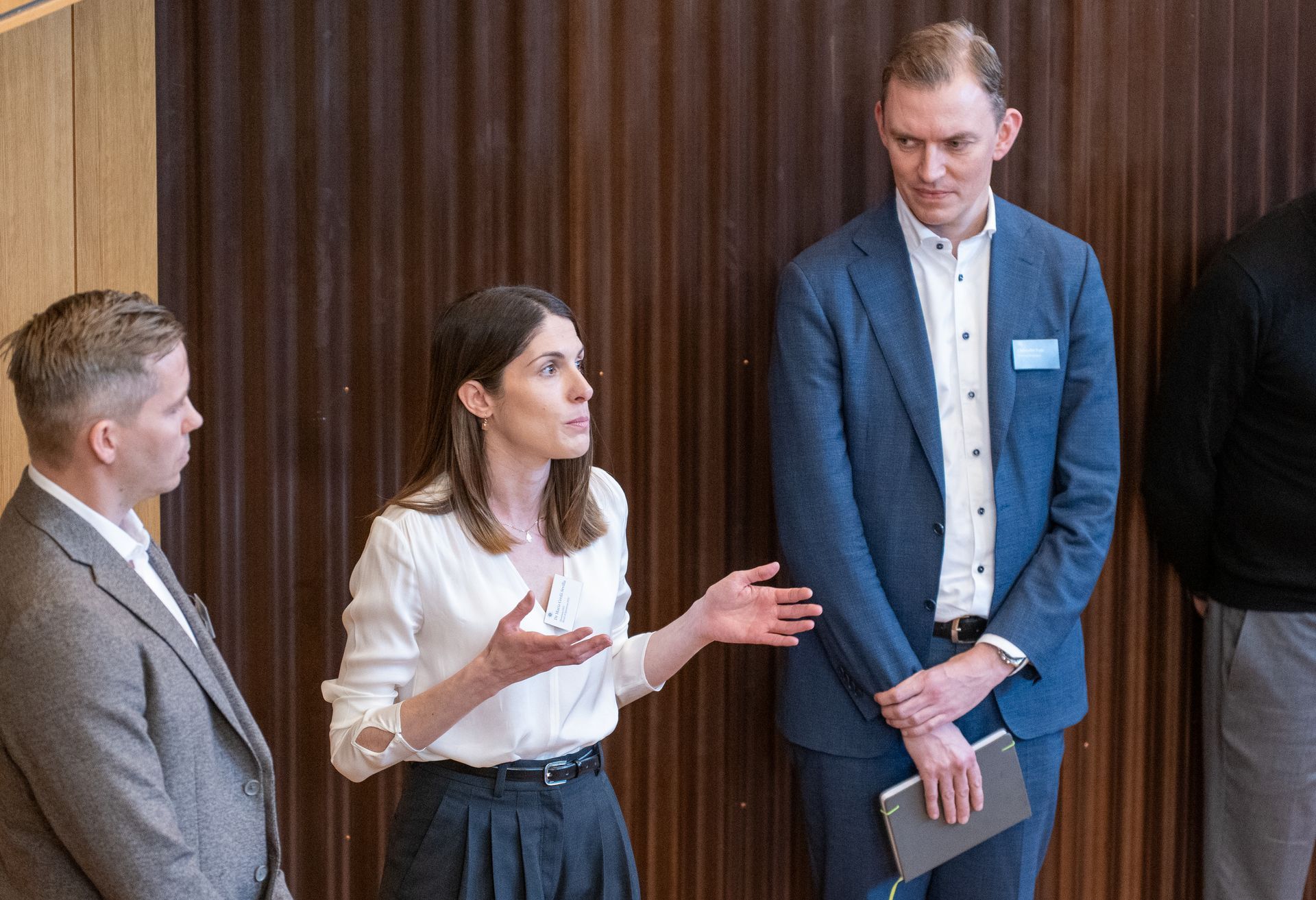
The event concluded with a panel discussion examining whether Denmark can realistically scale infrastructure for the next wave of computing. Participants included Marc Christensen from Digital Realty, Nicolai Haaning from Rambøll, Poul Kjeldgaard from Dell, Maria Cerdá Sevilla from DTU, and Christoffer Fode from Gorrissen Federspiel.
From a research perspective, Maria Cerdá Sevilla emphasized that quantum technologies remain in early stages, but that global investment and collaboration are accelerating. The panel also discussed how future applications in areas such as life sciences, materials research and optimization could combine AI and quantum systems in new ways.
Several panelists pointed to Denmark’s strong research environment, renewable energy profile and growing digital infrastructure ecosystem as important advantages. Realizing that potential will require stronger coordination between energy systems, digital infrastructure planning and long-term technology policy.
The next wave of computing will not only be shaped by research breakthroughs. It will also depend on the infrastructure capable of running those technologies at scale.

Contact us

Christine Kjær Jacobsen
Head of Marketing & Communication
chja@datacenterindustrien.dk
+45 2975 2932