

How do we build the digital and green infrastructure Denmark will need - at the same time? That question set the frame when the Danish Data Center Industry (DDI), together with Business Esbjerg and ProVarde, brought municipalities, the energy sector, public authorities and the data centre industry together in Esbjerg to kick off Nordic Data Center Week. The day pointed to Western Denmark as a place where a new model for the interplay between energy, digital infrastructure and local growth can take shape.
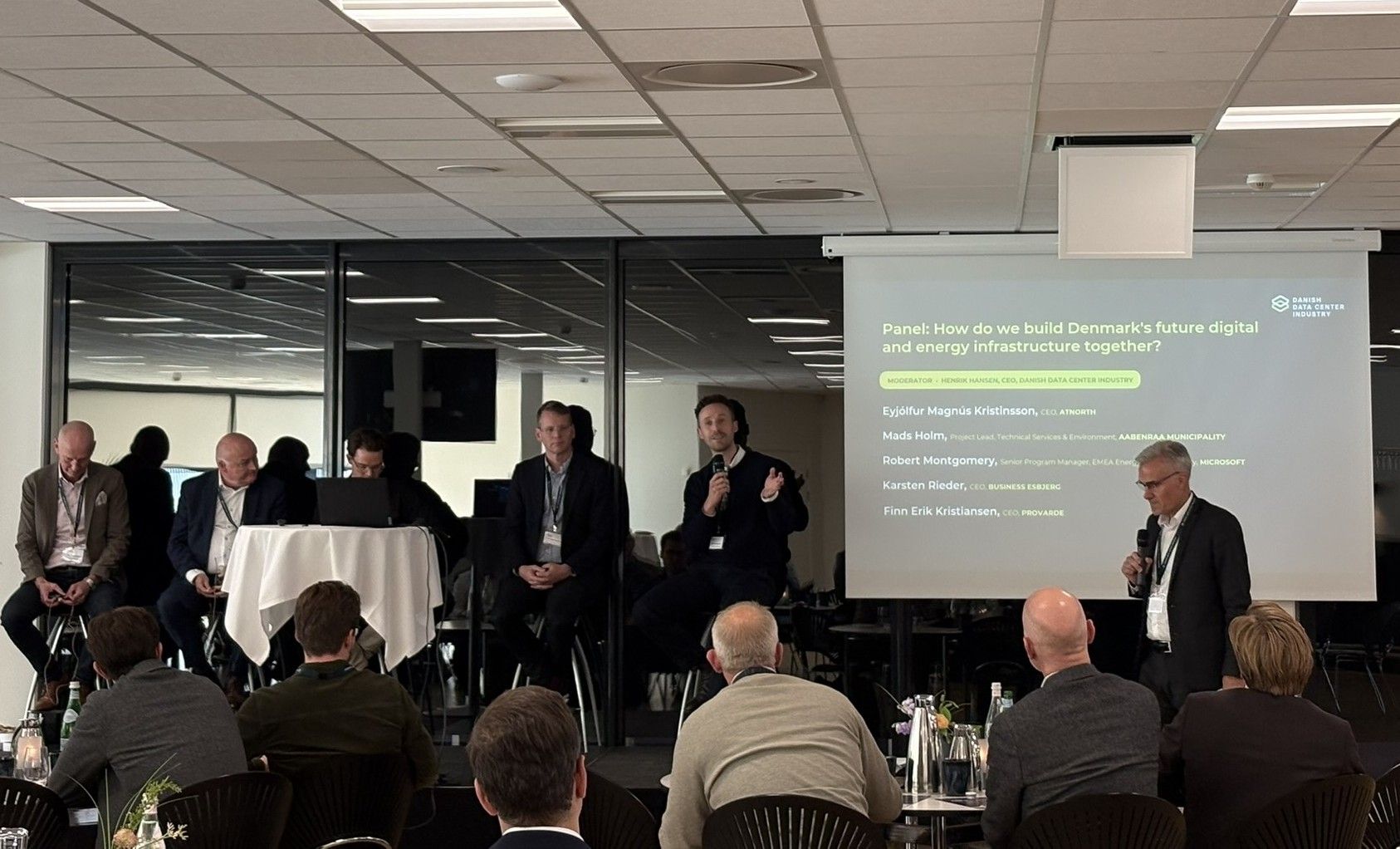
Picture taken from the Networking Meetup with the panel and Henrik, CEO of DDI as moderator.
Western Denmark already has many of the pieces needed to build the infrastructure of the future.
Large volumes of renewable energy. Strong energy companies and industrial value chains. International fibre connections. Land available for development. Skills in energy, offshore and technology. And now, growing interest from international data centre players as well.
But the potential will not realise itself.
That was clear after a full day in Esbjerg, where DDI first gathered a smaller circle of municipalities, energy companies, public authorities, investors and data centre players for a roundtable, and later opened the doors to a broader networking meeting.
Common to the discussions was a question that reaches far beyond the data centre industry:
Can we get better at planning the green and digital transition together - and can Western Denmark show the way?
From individual projects to a coherent infrastructure system
A recurring message from the roundtable was that Denmark has been ambitious on both the green and the digital agenda - but has not always planned the two developments together.
This is becoming ever clearer as society electrifies. Data centres, PtX, transport, industry and heat supply all need to be electrified at the same time as renewable energy production has to grow and the electricity grid has to be expanded.
This creates a capacity problem - but also an opportunity to think differently.
Instead of seeing a data centre solely as a large consumer of electricity, participants pointed to the opportunities in combining consumption, renewable energy production, batteries, flexibility, PPAs, excess heat and other industrial activities.
The discussion thus moved from the question of how much electricity a data centre consumes to the question of how large digital investments can form part of an integrated energy and industrial system.
Western Denmark has some particular strengths
This is precisely where Western Denmark becomes interesting.
Over decades, Esbjerg and Varde have built strong positions in energy and offshore. The region also has commercial land, energy infrastructure and digital connections at its disposal, and is seeing considerable interest in new data centre investments.
The ambition among local players is therefore bigger than attracting individual projects. The perspective is to connect digital infrastructure with the existing energy and industrial cluster.
At the networking meeting, Business Esbjerg and ProVarde highlighted, among other things, the opportunities to connect data centres with local energy production, excess heat, process water and a growing supplier ecosystem.
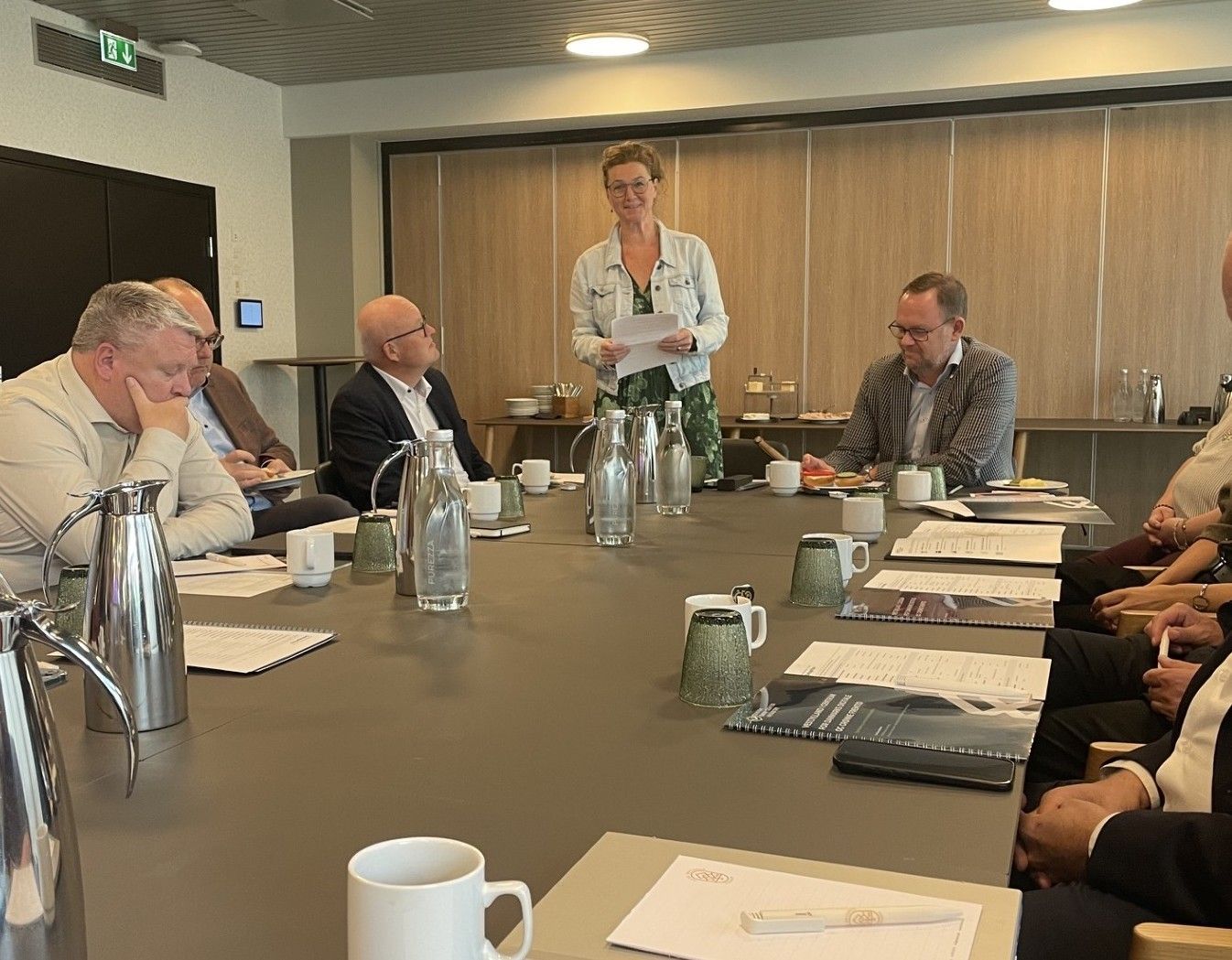
Picture from the Round Table Debate. On the picture standing up is Sarah Andersen, borgmester i Varde.
At the same time, Aabenraa Municipality showed how this way of thinking can already be translated into physical planning. In Kassø, work is under way on an integrated industrial park where renewable energy, PtX, data centres, heat and other industrial activities are designed into the same area.
The point is not that one model can be copied directly from one municipality to another. The point is that the siting of tomorrow's digital infrastructure should increasingly be seen in the context of the energy system and local business development.
The grid is the immediate bottleneck
There was no doubt, meanwhile, about the day's biggest challenge: the electricity grid.
Denmark is in the middle of a debate about how to prioritise scarce grid capacity, and data centres are among the large electricity consumers feeling the uncertainty.
But the discussion in Esbjerg also showed the limits of focusing solely on how existing capacity is distributed.
At the networking meeting, Marie Holm Thomsen from Green Power Denmark summed up the challenge across two time horizons: in the short term, Denmark has to manage the queue through, among other things, flexibility and grid-friendly solutions. In the longer term, the message is far simpler: more has to be built.
At both the roundtable and the networking meeting, participants also pointed to solutions that can ease the pressure on the grid: co-locating production and consumption, batteries, flexible consumption, PPAs and new models for local energy exchange.
That does, however, require clear frameworks. For companies investing billions and planning many years ahead, predictability about grid connection, capacity and terms is decisive.
Local value has to be felt
The day's discussion, however, was not only about megawatts and the grid.
Another recurring theme was local support.
Large infrastructure projects affect their surroundings. The industry therefore cannot expect support simply by explaining that data centres are necessary for cloud, AI and digitalisation.
Concrete value also has to be created where the infrastructure is built.
atNorth and Microsoft presented various examples of their work with local jobs and suppliers, education partnerships, excess heat, nature and local communities.
The message from both companies and municipalities was, at the same time, that there is no single model for local value creation. A project in Varde looks different from a project in the Greater Copenhagen area.
But the principle is the same: if data centres are to be part of the local community, the industry also has to be present in the local community.
Openness, early dialogue and a willingness to listen to concerns were highlighted as at least as important as technical solutions.
A Danish model for data centres?
That leaves a bigger question.
Denmark is currently debating the need for a national data centre strategy. Such a strategy should not be only about how many data centres Denmark wants.
It should also be about which data centres we need, where they make the most sense, how they connect to the energy system, and what value we expect them to create.
This is exactly where the experience from Western Denmark could become interesting.
Denmark has strong traditions in energy planning, district heating, sector coupling and public-private partnerships. If those capabilities are combined with the next generation of digital infrastructure, a distinctly Danish model could emerge: data centres developed not in isolation from the rest of society, but as an integrated part of the energy, industrial and local systems.
At the same time, this requires the industry to take on its own responsibility. Data centre operators must be able to document their contribution, be more flexible, work actively on local value creation and be willing to have the difficult conversations about energy, land use and impact on local communities.
Nordic Data Center Week began where the discussion is most concrete
It was no coincidence, then, that this year's Nordic Data Center Week was kicked off in Esbjerg.
The very purpose of the week is to open up the physical world behind our digital society and invite more people into the discussion about the infrastructure that cloud, AI and our digital everyday life are built on.
Esbjerg made for a very concrete starting point. Because Western Denmark already stands with both the opportunities and the dilemmas: large investments, growing demand for electricity, the need for more energy infrastructure, local growth and a desire to develop new green industrial ecosystems.
The question is therefore perhaps no longer whether the green and digital transitions belong together.
The question is whether we are ready to start planning them that way.
Contact us


Christine Kjær Jacobsen
Head of Marketing & Communication
chja@datacenterindustrien.dk
+45 2975 2932